Case study
Scottish Renewables
9 OF 9
Roles filled
100%
Offer to acceptance ratio
3 MONTHS
To complete the full project
1:1
CV to interview ratio
2:1
Interview to placement ratio
9 WEEKS
Average time to hire, from 6 to 12 weeks
Nine roles filled in three months, with 100% offer acceptance.
When Scottish Renewables restructured to better serve its members, Murray McIntosh was brought in to recruit nine roles across policy, communications and operations. Despite a limited budget, a small talent pool and political uncertainty, every role was filled within three months, with 100% offer acceptance and an average time to hire of nine weeks. Scottish Renewables is Scotland’s renewable energy membership body, bringing together industry, government and stakeholders to accelerate the transition to a cleaner, more secure energy future.
We delivered
TRUSTED BY SCOTLAND'S RENEWABLE ENERGY MEMBERSHIP BODY.
Our relationship with Scottish Renewables began in November 2025, after a referee for a candidate we had placed introduced us to the team. A conversation about replacing one role became four placements by March, each appointed within six weeks.
When the organisation began a restructure to better reflect what its members needed, we were invited to pitch for the whole project. Nine roles followed, and every one was filled.
THE CHALLENGE.
Scottish Renewables underwent a significant restructure to ensure it was better serving and reflecting the needs of its members. Some of the nine roles were new, mostly junior. Three head-of roles reintegrated essential talent and one was brand new. We had to fill them all in a difficult market:
- Limited budget. Large Scottish corporates can pay well above a membership body.
- A small talent pool. Renewables is central to Scotland’s identity, so competition is intense. The growth of Great British Energy drew talent from the sector, and small developers were closing, leaving some professionals questioning their future in renewables.
- Political uncertainty. Changing government positions on renewables and net zero added to the hesitancy.
- Technical and policy experience combined. Scotland’s renewables expertise is mainly engineering-led, and few candidates also had policy experience.
- Location. The organisation is Glasgow-based, so we had to establish how far candidates could realistically travel.
OUR PARTNERSHIP APPROACH.
- Appointed after pitching. Following the earlier placements, we presented our approach to the new Director of Finance and Operations. As we are not Scotland-based, we became a member of Scottish Renewables, elevating our involvement and commitment.
- Sector knowledge from day one. Our lead consultant had five years in the wider renewable energy market, including Northern Ireland. The first four placements showed us the culture and what it offers beyond salary.
- Close contact with the leadership team. We worked with the Directors of Finance and Operations, Onshore and Offshore Delivery, Public Affairs and Communications, and Energy Systems. Most contact was by video call, telephone and email, and we visited the Glasgow office to meet them in person.
- Honest advice. We tested each brief against the market. Where salary, experience, essential criteria or location were unrealistic, we said so and agreed where to compromise. Our earlier work made these conversations quicker.
- A specialist team. The team working on this project included Lead Consultant Anna Kelly, Consultant Ellie Diamond and Marketing Director Ashleigh Macfarlane.
SOURCING CANDIDATES.
- Around 65% of relevant talent was passive, so we headhunted from competitors, government and the major energy companies in Scotland.
- We took referrals from inactive candidates and mapped the market widely using our network.
- The Head of Communications role drew considerable interest. The technical pool was very small: grid and networks and onshore each had a shortlist of two, and both were placed. When talent is scarce, the value lies in knowing who is worth considering and meeting.
- Only around 3% of applicants were remotely relevant for Scottish Renewables.
Tools used
Candidate identification: Sourcebreaker, ZoomInfo and an enhanced LinkedIn Recruiter licence.
Advert distribution: Bullhorn CRM and Broadbean.
Candidate communications: Force24.
Wider reach: job boards, social media and client vacancy hubs, backed by an organically grown LinkedIn following of 32,000 with double the average engagement rate.
ASSESSING CANDIDATES.
The roles needed technical and policy knowledge together. The Head of Grid and Networks, for example, had to understand how all renewable energy technologies connect to one grid, and how the policy conversation with the grid and regulators works. Many candidates understood the connections and technologies, but not the policy.
Our process
- SLAs. Delivery of high-calibre candidates is governed by SLAs agreed with Scottish Renewables and updated at each stage, part of Murray McIntosh’s responsible recruitment framework.
- Screening. The same dedicated consultant screened each brief on receipt: CV and application review, skills and competency matching, agreed assessment criteria, behavioural fit and Right to Work checks.
- Role-specific questions. Rather than relying solely on CV evidence, we translated the requirements of each role into focused, competency-based qualification questions. Candidates were asked to provide specific examples explaining the context, their personal contribution and the outcome achieved. The questions were tailored to the responsibilities and seniority of each appointment. Examples included:
- Strategic communications: “Tell us about a communications strategy or narrative you developed to support organisational or policy objectives. What was your approach, and what evidence showed its impact?”
- Policy influence: “Describe a policy, planning or regulatory issue you helped influence. What evidence did you use, who did you engage and what changed as a result?”
Technical policy leadership: “Give an example of a complex technical or regulatory issue on which you developed an evidence-based position. What was your contribution, and what outcome did it influence?” - Stakeholder engagement: “Tell us about a time you brought together stakeholders with differing views. How did you build consensus and secure a clear way forward?”
- Marketing and audience engagement: “Give an example of a campaign you helped deliver. Which channels did you use, and what evidence demonstrated its effectiveness?
This approach enabled us to test both the relevance and depth of each candidate’s experience, distinguish individual contribution from wider team activity, and give the client a consistent evidence base on which to compare the shortlist.
- Interview. Candidates who successfully passed the screening stage were invited to a two- stage interview process. The initial interview focused on career history, motivations and overall alignment with the role and organisation, giving both parties the opportunity to assess mutual fit. Final-stage interviews were more in-depth and competency-based, exploring technical expertise, problem-solving capability, stakeholder engagement and the behaviours required to deliver successfully within Scottish Renewables’ collaborative and purpose-led environment.
- References. We took two professional references for every placement.
Our standards
- A Disability Confident Committed Employer, we adapt testing and interviews so every person is assessed fairly on their ability to do the job.
- Our consultants are trained in responsible recruitment and modern slavery awareness.
- We are APSCo and BIoR members, and all consultants complete BIoR training, including the Essential Law and Legislation module.
- We are progressing towards ISO 9001, ISO 14001 and Cyber Essentials certification, and our GDPR and Privacy Policy is audited annually.
SELLING SCOTTISH RENEWABLES.
- We were transparent with candidates who could command higher salaries elsewhere, positioning Scottish Renewables’ unique blend of sector influence, visibility and purpose as a compelling alternative to larger corporate environments. This enabled many candidates to view the opportunity through a broader career lens and demonstrate flexibility on remuneration.
- We addressed concerns arising from organisational and sectoral change by clearly articulating the organisation’s direction, leadership vision and longer-term ambitions.
- The successful Head of Onshore Policy candidate was not actively looking to move, requiring careful positioning of the opportunity and its sector-wide influence to convert initial curiosity into genuine interest.
A VACANCY HUB TO ELEVATE THE EMPLOYER BRAND.
https://www.murraymcintosh.com/microsites/Scottish-Renewables
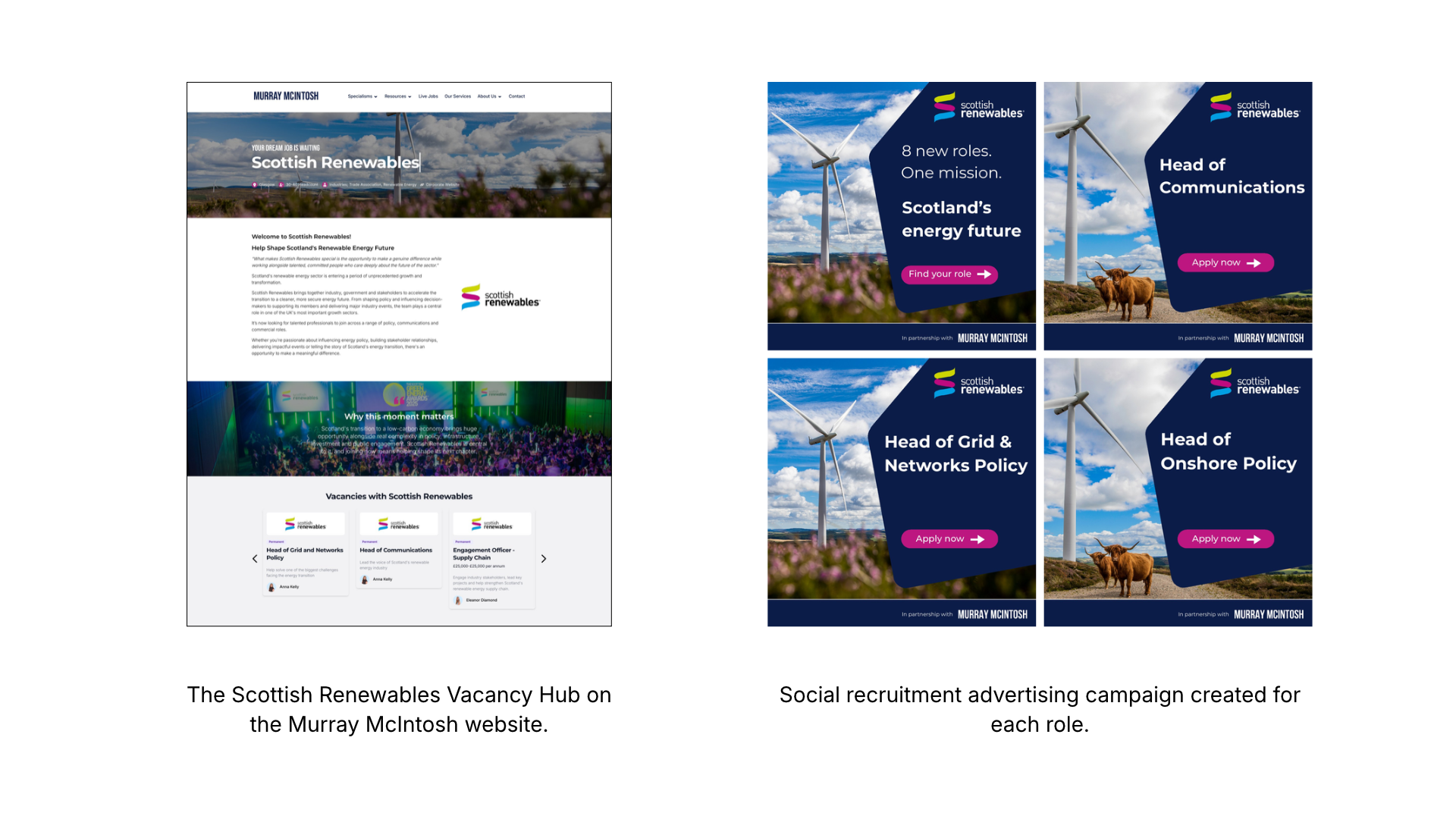
To support the search, we created a dedicated Vacancy Hub for Scottish Renewables:
- All nine roles in one place, with everything candidates needed.
- A video from Jack Norquoy, Public Affairs and Communications Director, on what makes Scottish Renewables different and why people should join the team.
- Bespoke advertising for each role, posted organically on LinkedIn to drive traffic to the hub.
- The hub elevated the employer brand and helped to attract and engage candidates.
SECURING AND KEEPING THE RIGHT PEOPLE
We worked with Scottish Renewables to widen the search by location and experience, and to offer flexibility where candidates needed it. One candidate was offered a nine-day fortnight, and two candidates from Eastern Europe were given the option to work abroad over the summer so they could spend time with family.
That support continued after placement. A permanent hire only succeeds if they settle in and stay. Our dedicated consultant held check-in calls with both the hiring manager and the candidate the week before the start date, on day one and at the end of the first week. After that, check-ins ran monthly, quarterly or annually, depending on what suited Scottish Renewables and the new colleague. Each call confirmed the candidate was settling in and suited to the role, gathered feedback from both sides and gave everyone an early route to raise concerns.
The result: all nine roles were filled within three months, with a 100% offer acceptance rate and an average time to hire of nine weeks. An organisation without the biggest budget can still secure strong talent, provided it understands where it can compromise and what it offers beyond pay.
MORE ABOUT MURRAY MCINTOSH.
Founded in 2015, Murray McIntosh was established to offer a research-led, specialist recruitment service. Since then, we've earned a reputation as a trusted partner, working with clients ranging from innovative start-ups to global multinationals to secure the talent needed to deliver.
Our Policy, Public Affairs, Strategic Comms & Economics team deliver highly targeted support, backed by genuine insight and sector knowledge.
We also offer strategic, complementary advice across recruitment process design, employer branding, and workforce planning. Our services cover both permanent and contract recruitment, tailored to meet the specific needs of each client.
We remain embedded in our markets by actively participating in industry events, panels, and working groups, keeping us informed, engaged, and always one step ahead.